
It is late. The kids are finally asleep. And you are sitting on the edge of the bathtub with your phone, typing “how much does mold remediation cost in Oklahoma City” for the third time tonight.
Every result gives you a different answer. One site throws out a neat price per square foot. Another shows a range so wide it is basically useless. A company you called earlier would not say a number at all, which somehow made you trust them less. And now you are not just worried about the mold. You are worried about getting played.
I am Phil Sheridan. I own 4D Restoration here in Edmond, and I am going to give you the honest version of the answer. It is going to feel less satisfying than a tidy number on a screen. It is also the only version that will not cost you more later.
So let me start with the part nobody wants to say out loud.
Why I cannot give you an honest price over the phone
The price of mold remediation depends almost entirely on things I cannot see through a phone.
Mold is never the real problem. Mold is what water leaves behind. So before I can tell you what a job costs, I have to know where the water went, how long it sat, what it soaked into, and how far it traveled while nobody was looking. None of that fits in a phone call.
A number I give you before I have seen the wall is not a quote. It is a guess with a dollar sign on it.
I know that is not what you were hoping to read. Here is the thing worth knowing though: that gut feeling you had earlier, the one where the confident phone quotes felt more like a sales move than an answer, that instinct is correct. You are not being paranoid. You are doing the smart thing, which is refusing to hand over your money to whoever sounds the most sure. The research reflex that put you on your phone at eleven at night is the same reflex that keeps you from getting fleeced. Trust it.
Now let me actually earn my keep and tell you what the number is really made of.
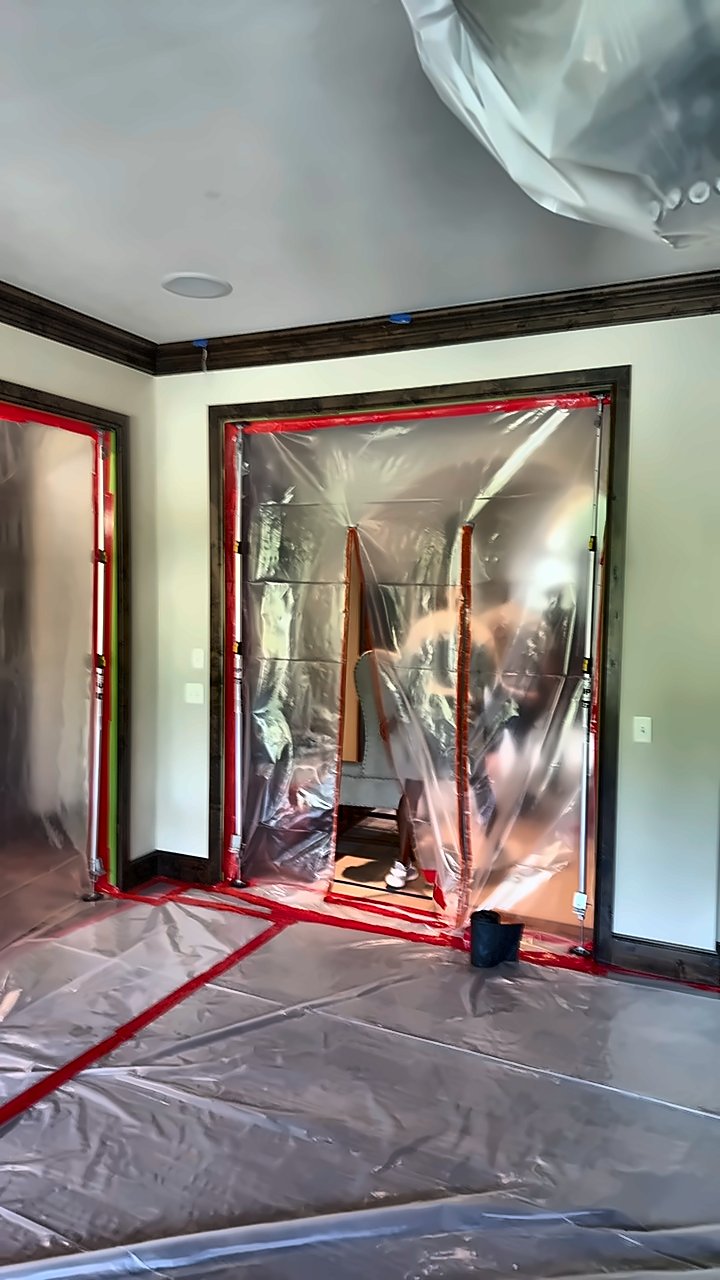
This is part of what a real quote pays for: floor sheeted, every doorway sealed with plastic and zip barriers, poles holding the walls tight. Containment is labor and materials — and it’s the difference between a problem in one room and spores in five.
The five things that actually decide what mold remediation costs
Every honest mold quote in Oklahoma City comes down to these five levers. Once you understand them, the wildly different numbers you have been seeing online start to make sense.
1. How far it actually spread
The patch of mold you can see is almost never the whole map. Water wicks sideways through drywall, runs down the back of a stud, and sets up shop in the next room over while the wall in front of you looks fine.
When I come out, I do not guess at the edge of the problem. I find it. I use a moisture meter and a FLIR thermal camera to see where the wet material actually stops, not where the visible stain stops. A job that is one square of drywall behind a toilet and a job that quietly followed a roof leak into three rooms are not the same job, and they are not the same price. The spread is the single biggest driver of what you will pay.
2. What materials the mold got into
Some materials clean up. Some have to come out.
A sealed, non-porous surface can often be cleaned and saved. Porous materials that drank up the water, like drywall, carpet, and the pad underneath it, frequently cannot be trusted once mold is in them, so they get removed and replaced. What the mold got into changes how much labor and disposal the job takes, which changes the price. Two jobs with the exact same square footage can land in very different places depending on whether we are wiping down framing or hauling out saturated material.
3. How much containment the job needs
This is the step the cheap operators love to skip, and it is the one that protects the rest of your house.
Mold spreads by spores. The moment you start disturbing it, you are putting those spores in the air, and if that air drifts into clean rooms, you have just turned a one-room problem into a whole-house problem. My team seals the work area, puts it under negative air pressure so nothing escapes, and runs HEPA air scrubbers that pull 99.97 percent of airborne spores and allergens out of the room. A job that needs a small containment and a job that needs half your house sealed off are priced differently, for good reason.
One of our customers, Lindsay Sloan, put it in a way I could not improve on. She wrote that my technician Derrick and I are “no pressure, but no nonsense,” and she noticed that the crew “vacuumed outside the contained area before leaving.” That is not us going above and beyond. That is just the standard. Containment you cannot see is still part of what you are paying for.
4. Whether the job needs lab testing
Sometimes you genuinely need testing. Sometimes paying for it is money down the drain.
If we can see the mold and we know the source, testing the obvious often just adds cost without changing the plan. Where testing earns its keep is when the problem is hidden, when someone in the home is sick and a doctor wants to know what they are breathing, or when you need documented proof that the air is clean after the work is done. Part of my job is telling you which situation you are in, honestly, instead of ordering every test on the menu.
A customer named Jaysie Clifford wrote that our crew “thoroughly educated us on mycotoxins and all the ends and outs” and “helped us tremendously with insurance.” That is the version of this business I want you to get. You should leave the conversation understanding what you are paying for, not more confused than when you started.
5. What your insurance covers
This lever does not change what the job costs. It changes what comes out of your pocket, which is the number you actually care about. It is big enough that it gets its own section below.
Why the cheapest quote is usually the most expensive one
Let me walk you through how the lowball works, because once you see the move, you cannot unsee it.
A company gives you a number that feels great. It is lower than everyone else. It anchors in your head, and now every other quote feels like a ripoff by comparison. You sign. Then the job “grows.” There is more damage than expected. There is a fee that was not mentioned. The containment they skipped means spores got into two more rooms, so now those need remediation too. The final bill sails right past what the honest quote would have been in the first place.
A cheap number that becomes an expensive bill is not a discount. It is a down payment.
I am not telling you this to scare you off of shopping around. Shop around. I am telling you because I have cleaned up after the cheap version more than once. A customer named Candice hired a cheaper company first. It did not go the way she hoped, and afterward she wrote that we were “knowledgeable and honest guys” and ended her review with four words that belong on a wall: “You get what you pay for.”
When you compare quotes, do not just compare the number at the bottom. Ask whether containment is included. Ask whether the crew is IICRC certified. Ask whether they are licensed in Oklahoma and carry their own liability and workers’ comp insurance. The quotes that look cheapest are often cheap because something that protects you got quietly left out.
What insurance actually covers in Oklahoma
Here is where I put on my advocate hat, because this is the part where people either get their money back or leave it on the table.
The short version: mold coverage in Oklahoma usually depends on what caused the mold. If the mold grew out of a sudden, accidental water problem that your policy already covers, like a pipe that burst, you often have a real claim. If it grew slowly out of a leak that was ignored for a year, or out of flooding from outside the home, most standard policies will not touch it. And even when mold is covered, most policies cap how much they will pay for it. That cap is why the details matter so much.
This is exactly why the water damage matters as much as the mold. Mold is the aftermath. The water damage that caused it is usually the thing your policy is actually written around, so getting that story documented correctly is half the battle.
What we do is document everything. Photos, moisture readings, notes, the whole record, built the way an adjuster needs to see it. Then we speak directly to your adjuster so you are not stuck translating between two worlds that do not speak the same language. A customer named Brittany Venable wrote that our crew “took great photos and notes for insurance, monitored daily… 10/10.” That paper trail is not busywork. It is what puts weight on your side of the table, and it is the difference between a claim that gets paid and one that gets picked apart. If you want the full picture of how we handle the paperwork, that lives on our insurance claims page.
One more thing, and this one is a law, not an opinion. In Oklahoma, the choice of who does the work is always yours. Your insurance company can suggest a company. They cannot assign you one. Choose who you trust, not who your insurer points you toward.
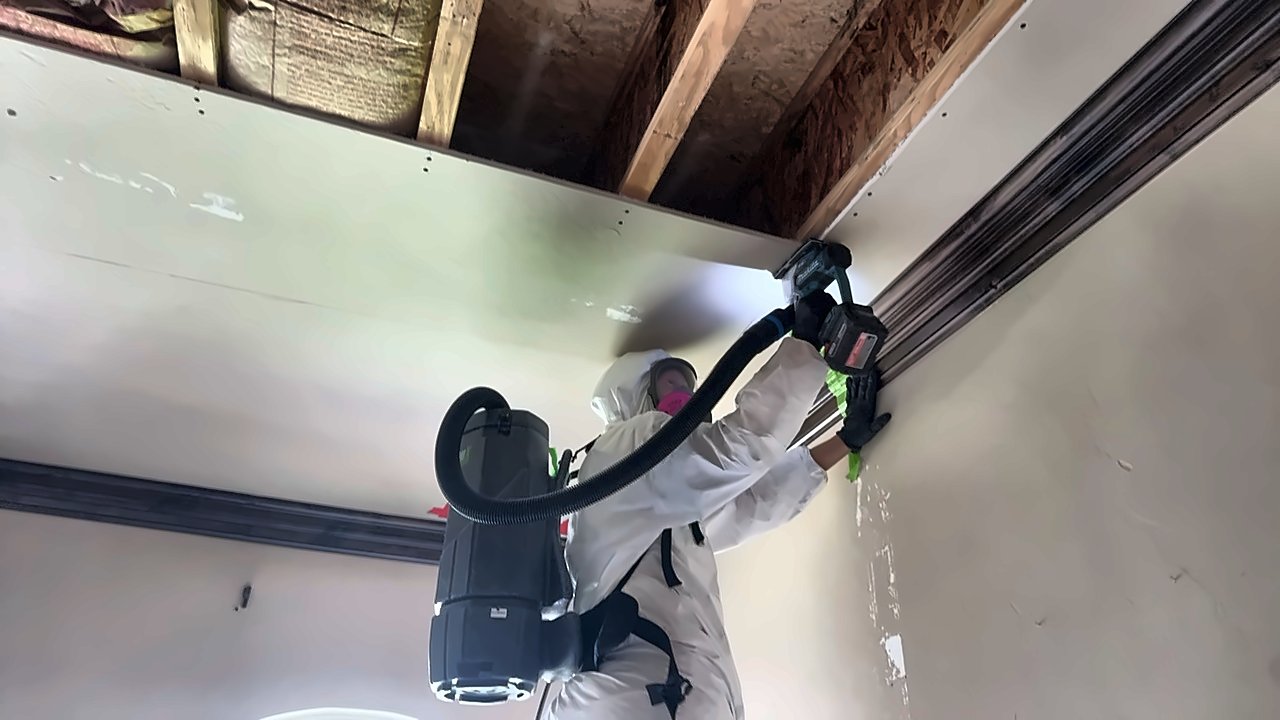
Overhead removal in full protection: our tech works an opened ceiling with the tool feeding straight into the backpack HEPA vac, joists and insulation exposed above. It is slow, contained work, and it is exactly what an honest mold bid covers.
How the free on-site assessment gives you a real number
So if I will not quote you over the phone, how do you actually get a number? You get me out to the house.
The assessment is free, and there is no obligation attached to it. I walk your home with a moisture meter and a thermal camera and I find the real edge of the water, the part the stain on the wall is hiding. I tell you what has to come out and what can be saved. I tell you whether you actually need testing or whether that would just be me spending your money. And then you get a real scope, built on what is actually there instead of what I hoped was there.
That is the moment all the anxiety you have been carrying since eleven o’clock finally has somewhere to go. You have been trying to make a decision with a hole where the facts should be, and no online range and no confident phone quote was ever going to fill it. A real number, measured in your actual house, is the only thing that does.
It is mold. It is a serious situation, and it is also a completely solvable one. We contain it, we remove it, we dry the structure with industrial dehumidifiers so it does not come back, and we treat what is left with botanical antimicrobials that smell more like thyme than bleach. You are going to be fine. You just need the real number first, and the real number starts with a look.
What to do right now
If you have visible mold, a musty smell you cannot place, or water damage that you already know is behind this, do not sit on it. I am not going to hit you with a fake countdown, because I do not do scare tactics. But I will tell you the plain truth: every day that wet material stays wet, the mold keeps working, and a small job quietly turns into a bigger one. Time is the one cost driver you actually control.
The fastest way to a real answer is to call me. If you would rather text, text. Either way you reach a person, not a call center. And if you want to understand the whole process before you pick up the phone, read through how we handle mold removal start to finish so you know exactly what you are buying.
Call or text 405-896-9088. I will give you the honest answer, in person, with a moisture meter in my hand.
Frequently asked questions
Can you just give me a ballpark price? Not an honest one, and I would rather tell you that than make one up. A ballpark that is not based on your actual house is a guess, and guesses are how people end up with change orders and surprise fees. What I can promise is that the on-site assessment is free, and after it you will have a real scope and a real number, not a range off the internet.
Why is mold remediation so expensive? Usually it is not the mold that is expensive. It is the water damage behind it, the materials that have to come out, and the containment that keeps spores out of your clean rooms. Here is the part people do not expect me to say: a real assessment fairly often finds the problem is smaller than you feared, and the job is more affordable than the worst-case number stuck in your head. You do not know which way it breaks until someone measures it.
Will my homeowners insurance pay for it? It depends on what caused the mold. If it came from a sudden, covered water problem like a burst pipe, you often have a real claim, though most policies cap how much they pay toward mold. If it came from a long, ignored leak or outside flooding, most standard policies will not cover it. We document the whole thing for your adjuster and, in most covered cases, what you pay is just your deductible.
Should I just do it myself to save money? For a small surface patch, careful cleaning can be fine, and I will never talk down to you for trying. The trouble is the part you cannot see. If there is still moisture in the wall or spores in the air, a surface wipe-down makes it look solved while the real problem keeps growing, and you end up paying for both rounds. If you are not certain the moisture source is dead, get eyes on it before you commit a weekend to it.
Is a cheap quote ever okay? Sometimes, if it is cheap for an honest reason and not because something that protects you got left out. Before you sign the low number, ask three questions: Does it include containment? Is the crew IICRC certified and licensed in Oklahoma? And does their air scrubber actually vent outside? If the answers are yes, a good price is a good price. If they get vague, the low quote is a trap wearing a discount.