
You’ve Smelled It for a While Now. You Just Haven’t Said It Out Loud.
There’s a smell in the back bedroom. Or the hall closet. Or it hits you for a second when the air conditioner kicks on. You’ve noticed it for weeks — maybe longer. You cleaned. You wiped down the baseboards, lit a candle, told yourself it was the dog or the old carpet. And it came back.
Here’s the part nobody says out loud: most people wait. They wait months. Not because they’re careless, but because the smell is vague, the wall looks fine, and calling somebody feels like admitting the problem is real.
I’m Phil Sheridan. I own 4D Restoration here in Edmond, and I’ve walked into hundreds of Oklahoma homes where the homeowner apologized for “probably wasting my time.” You’re not wasting anybody’s time. You noticed something your house was trying to tell you. Let’s figure out what it is.
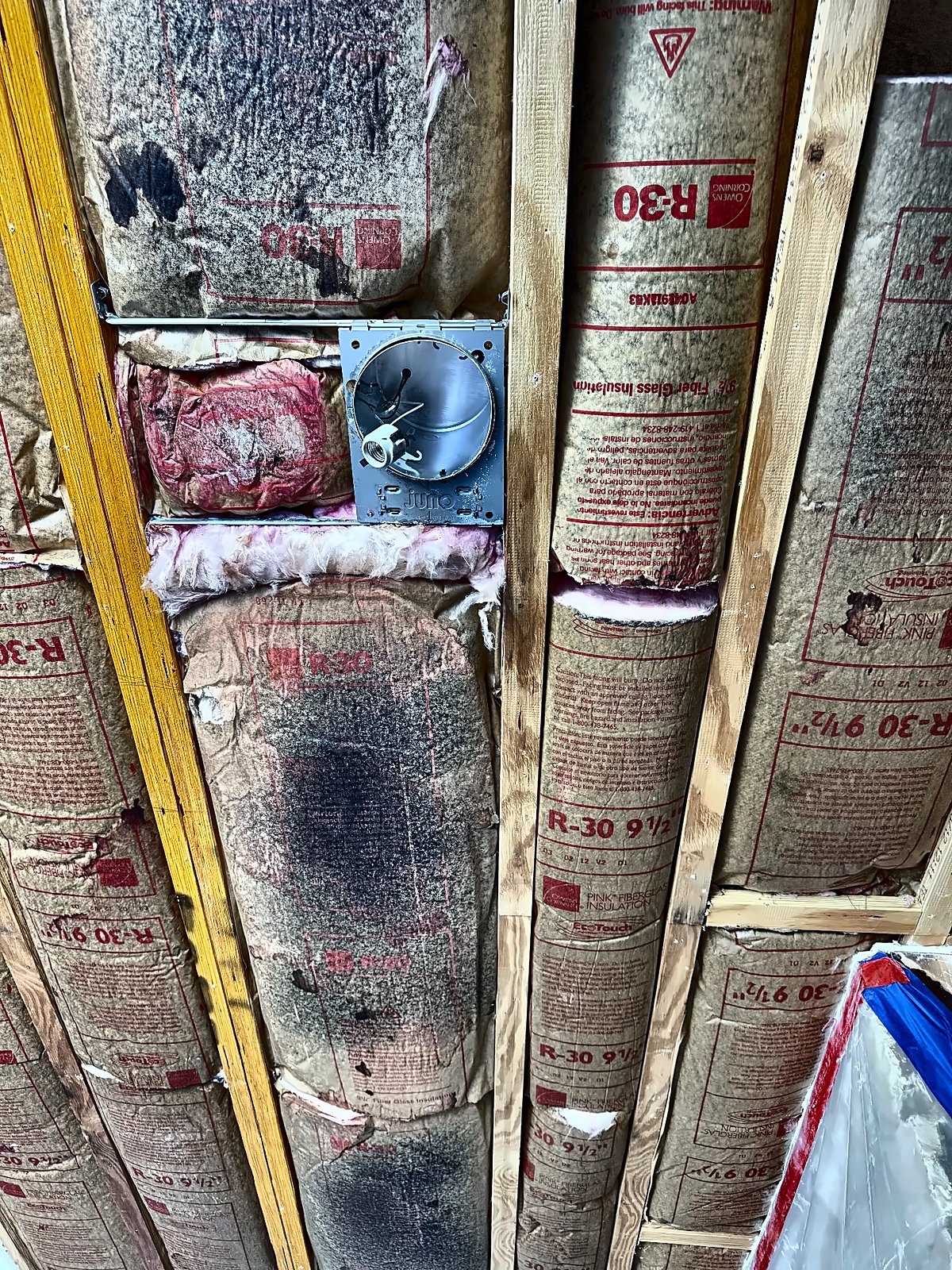
What we found once the wall came open: heavy dark staining across the insulation’s paper backing, invisible from the finished side. Documented on site during one of our inspections — this is why a musty smell deserves a look inside the wall.
Why You Smell Hidden Mold Before You Ever See It
This is the thing that trips everybody up, so let me clear it first — because once you understand it, the guilt goes away.
Mold behind a wall isn’t hiding from you on purpose. It grows where the water and the food are: on the back side of the drywall, inside the wall cavity, under the paper. That’s the side you never see. The reason you can smell it anyway comes down to a piece of building science that explains the whole mystery.
As mold grows, it gives off gases. Researchers call them MVOCs. And the finding that matters for you is this: those gases pass right through wallpaper and slip into the small crevices drywall can’t seal, which makes them ideal for revealing hidden mold. In plain terms — the smell reaches your nose long before the mold reaches your eyes.
So when you cleaned the surface and the musty smell came back, you didn’t fail. You cleaned the wall you could see. The source was on the other side of it, still fed by moisture, still giving off that smell. That’s not a you problem. That’s just where mold lives.
The Real Signs Mold Is Behind Your Walls
Hidden mold rarely gives you one dramatic clue. It gives you a few quiet ones that add up. Here’s what I actually look for.
A musty, earthy smell that keeps coming back. This is the big one. Not a one-time whiff — a smell that returns after you clean, gets stronger in a closed-up room, or shows up when the air handler runs. Trust your nose here. It’s a better early detector than most people give it credit for.
The wall telling on itself. Look for staining or a brownish shadow bleeding through the paint. Paint that’s bubbling, cracking, or peeling in one spot for no obvious reason. Wallpaper wrinkling or lifting at a seam. Drywall that feels soft or spongy when you press on it, instead of firm. A patch of wall that looks slightly swollen or warped. Any of these means moisture has been sitting in that material — and where moisture sits, mold follows.
A moisture history you can point to. Think back. A roof that leaked during one of our spring storms. A slow drip under a sink you “fixed.” An AC unit or water heater that overflowed. A pipe behind the wall that sweated all summer. Mold doesn’t appear from nowhere. There’s almost always a water event in the story, even a small one you’d forgotten. The research is blunt on this point: standing water and wetting events drive mold far more than the humidity number on your thermostat. It’s the leak, not the weather report.
Health cues that follow you home. This one’s subtle, so hold it loosely. If someone in the house has congestion, sneezing, headaches, or a “cold that won’t quit” that eases up when you leave for a day or two and comes right back when you walk in the door — that pattern points at the building, not at your immune system. Mold spores are small enough to breathe deep into your lungs, and mold sheds even smaller fragments alongside them. I’m not going to tell you mold is going to kill you; that’s not honest, and fear isn’t my product. But if the symptoms track with the house, it’s worth taking seriously. If you want the straight science without the internet hysteria, we wrote a whole piece on what mold actually does to your health.
One sign on its own might be nothing. Two or three of them lining up — especially a returning smell plus a leak you remember — is your house telling you to look closer.
When It’s Probably Nothing to Worry About
I’d be a lousy neighbor if I only listed the scary stuff. Plenty of the calls I take turn out to be nothing, and I’ll tell a homeowner that to their face rather than sell them a job they don’t need.
A bathroom that smells musty right after a hot shower and clears out once the fan runs is usually just condensation and airflow — not a wall full of mold. A little surface mold on tile grout or a window frame is a cleaning-and-ventilation issue, not a hidden-mold one. A smell that showed up once, after you left the windows open in a rainstorm, and never returned is probably gone. And a spot you already cleaned that has stayed clean and dry for a couple of months is behaving like a spot that’s actually fixed.
The dividing line is simple. Surface mold you can see and reach, on something that dries out, is manageable. A smell or a stain that keeps coming back, tied to a place that stays damp, is the one worth a closer look. When you’re not sure which one you’ve got — that’s exactly what an assessment is for. Guessing is the expensive part. Looking is cheap.
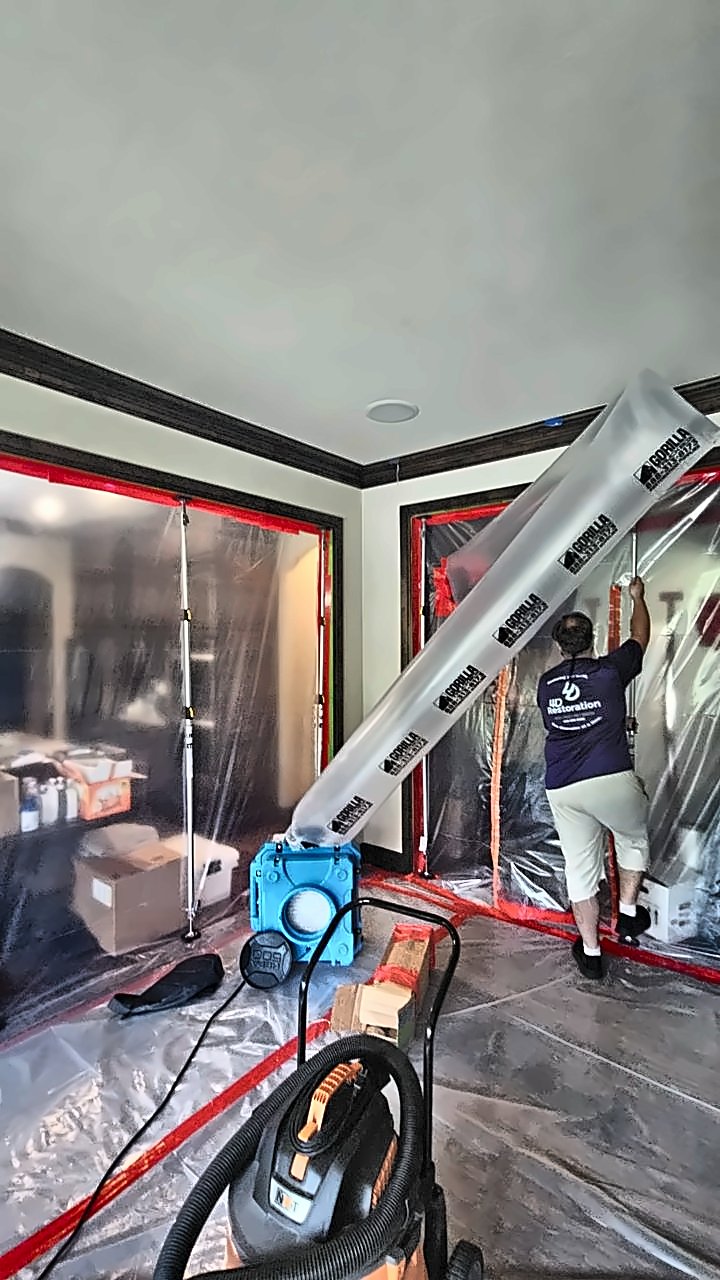
Inside the containment on one of our mold jobs: the zone is sealed in plastic and red tape, and the air scrubber runs its duct out of the space so everything we disturb gets pulled through filtration instead of settling back into the house.
Why You Can’t Just Bleach It or Cut a Hole and Peek
I get why the instinct is to grab a spray bottle or a drywall saw and settle it yourself. Hold off a second, and let me save you some grief.
Bleach is the classic mistake. On a porous surface like drywall or wood, it doesn’t reach the roots — it mostly wipes the color off the top and adds water, which the mold is thrilled about. We broke down exactly why bleaching mold tends to make it worse, because it’s the single most common thing I see people do before they call.
Cutting an exploratory hole is its own trap. The second you open a wall cavity with active growth, you can send a cloud of spores into the rest of the house — the air handler grabs them and spreads them room to room. That’s the whole reason my team works behind sealed containment and negative air pressure instead of just opening things up. It’s not overkill. It’s the difference between a problem in one wall and a problem in five rooms.
How We Actually Find Mold You Can’t See
Here’s the part that takes the mystery out of it, and it’s genuinely less invasive than people fear.
When you call, you get me. I’ll come take a look, listen to the history, and tell you straight what I see — no script, no scare tactics. For water, mold, or fire caught early, that first inspection is on the house.
Finding concealed mold doesn’t start with tearing your walls apart. It starts with reading them. My team runs a moisture meter across the suspect areas to find where water is actually sitting — because in the field, a moisture reading and a trained eye pin down the problem faster than any air test. We back that up with a FLIR thermal camera that sees the cool signature of moisture inside a wall, and inspection cameras that let us look inside a cavity through a hole the size of a coin instead of a demolition.
That’s the whole point of a proper mold inspection: we confirm whether there’s actually a problem, and exactly where it is, before anyone swings a hammer. If there’s nothing there, I’ll tell you that and you’ll sleep better tonight. If there is, you’ll know the real scope instead of imagining the worst. Either way, you stop guessing.
If we do find it, the path is boring on purpose: contain the area, remove what’s growing, treat what’s left with EPA-approved antimicrobials that smell more like thyme than bleach, dry the source so it can’t come back, and check our work. It’s mold. It’s not plutonium. It gets contained, removed, and dried out, and you get your house back. You can read how we handle professional mold removal and remediation from start to finish, and if your suspicion is up in the attic or a crawl space, we cover hidden mold in attics and crawl spaces too.
A Norman homeowner we helped after a hidden HVAC leak put it about as plainly as it gets: “They do exactly what they say. So professional!” That’s the standard I hold my team to — do what we said, when we said, no drama.
What to Do Next
If you’ve got a musty smell that keeps coming back, a stain or some bubbling paint you can’t explain, or a leak in your history and a hunch you’ve been ignoring — that hunch has earned a phone call.
Call me at 405-896-9088. If it’s easier to text, that number takes texts too — send a photo of the spot and a sentence about what you’re smelling, and I’ll tell you whether it’s worth coming out. There’s no charge to ask, and no upsell waiting on the other end. The worst outcome is that I tell you it’s nothing and you feel a little silly for a minute. The good outcome is you catch a small problem while it’s still small.
You didn’t do anything wrong by waiting. You’re doing the right thing now.
Frequently Asked Questions
Can I just cut a hole in the drywall and look for myself? I’d rather you didn’t, and not because I want the job. If there’s active mold in that cavity, opening it releases spores into the rest of your house, and your AC spreads them. If you’re determined to peek, do it with the room closed off and the HVAC shut down — but honestly, a coin-sized inspection-camera hole tells us the same thing without the mess.
If I fix the leak, will the mold behind the wall just dry up and go away? Fixing the water is step one, and it’s the most important step — no moisture, no new growth. But drying it out doesn’t remove what already grew. The material that’s colonized has to come out, or you’ll keep smelling it and the spores keep shedding. Stop the water, then remove the growth. Both, not one.
Will my homeowners insurance cover hidden mold? Sometimes. Mold is usually only covered when it grew from a covered event — like sudden, accidental water damage — and most policies cap what they’ll pay on mold specifically. The leak that caused it often matters more to your claim than the mold itself. When you call, I’ll document everything and speak to your adjuster directly, so you’re not fighting that paperwork alone.
How do you find mold without tearing my whole house apart? Moisture meters, a thermal camera, and inspection cameras. We read the walls before we open them. Most of the time we can tell you where the problem is — and where it isn’t — through a hole smaller than a light switch, so we only open what actually needs opening.
I’ve been smelling it for months. Did I make it worse by waiting? You’re far from the only person who waited, so let’s drop the guilt — it doesn’t help us fix anything. Mold does keep growing as long as it stays wet, so sooner is better than later. But “later” is still a lot better than “never,” and you’re here now. That’s the part that counts. Let’s go look.
Phil Sheridan. Owner, 4D Restoration. IICRC Certified. Edmond, Oklahoma. 405-896-9088.