
The Storm Passed. Now There’s a Stain on the Ceiling That Wasn’t There Yesterday.
It’s late. The wind has died down. You’re walking through the house checking on things, and there it is over the hallway or the back bedroom: a brown ring on the ceiling, spreading a little wider than it was an hour ago. Maybe there’s a slow drip into a pan. Maybe the drywall feels soft when you press it. And the question landing in your stomach is the one everybody asks me first: is this going to turn into mold?
I’m Phil Sheridan. I own 4D Restoration in Edmond, and my team handles water and mold across the Oklahoma City metro. Take a breath. This is a fixable situation, and you have more control over how it ends than you feel like you do right now. Let me tell you what’s actually happening inside that ceiling, what you can do tonight, and how the insurance side really works when a storm is the cause. No scare tactics. Just what I’d tell my own neighbor.
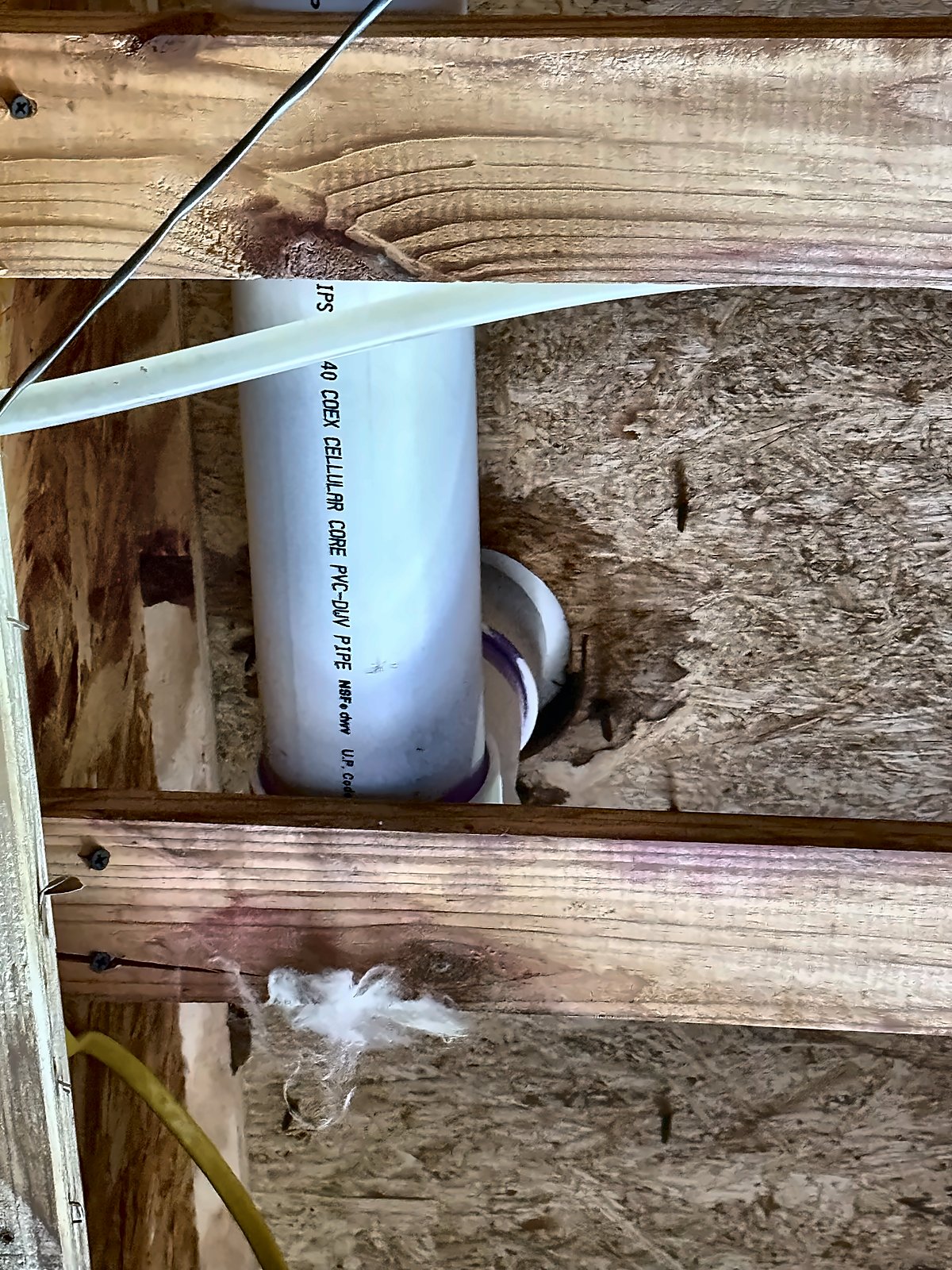
The look above the ceiling on one of our jobs: a drain line running through the framing and sheathing. When water gets into a cavity like this, it travels along the wood and surfaces in the ceiling far from where it started — which is why we open it up and check instead of guessing at the source.
Why Storm Water Turns Into a Mold Problem
Here’s the part most people don’t picture. When wind lifts shingles or hail punches the roof, water doesn’t politely stop at the stain you can see. It runs along the top of the drywall, soaks into insulation, wicks up wood framing, and pools in places you’ll never look. The wet spot on the ceiling is the smallest visible piece of a much bigger wet map above it.
Mold doesn’t need much to get going. It needs three things: a spore (already floating in every home in Oklahoma), something organic to eat (your drywall paper, wood, insulation, and dust all qualify), and moisture. Two of those three are permanent fixtures in any house. So the whole game comes down to the third one: how long the material stays wet.
And here’s the piece the science is very clear on, and that a lot of homeowners get backwards. It isn’t the humidity in the room that grows mold. It’s the liquid water sitting in the material. You can have a “comfortable” house and still be growing a colony inside a wall cavity where a storm dumped water two days ago. That’s exactly why a fan pointed at a stain, or a dehumidifier running in the hallway, can make the room feel dry while the problem quietly continues behind the surface. The air feels fine. The insulation is soaked.
Storm water makes this worse than a clean pipe leak, too. It drags in grit, roof debris, and outdoor spores, so it tends to invite a wider mix of molds than a tidy little damp spot under a sink. More food, more visitors, same rule: keep it wet and it grows.
The 24-to-48-Hour Window, and What It Actually Means
You’ve probably already read the number people repeat after every leak: dry it out within 24 to 48 hours. That one’s real, and it’s worth understanding instead of just panicking over.
The EPA’s homeowner guidance, “A Brief Guide to Mold, Moisture, and Your Home,” puts it plainly: if wet materials are dried within 24 to 48 hours, in most cases mold will not grow. That guidance lines up with the IICRC S500 water-restoration standard I’m certified in, which is built around getting materials back to a dry, normal moisture level fast. So the window is not marketing. It’s the actual biology of the thing.
But I want to take the fake countdown pressure off you, because that clock gets used to scare people into bad decisions. It is not a bomb timer where mold detonates at hour 49. It’s a threshold. Dry materials within a day or two and you’ve very likely dodged it. Let them stay wet and the odds climb every day. That’s the honest version: the danger isn’t the clock, it’s the water still sitting there. A wall that’s been wet for four days is a bigger job than one caught the next morning, not because a siren went off, but because the mold had four days of meals.
So no, you don’t need to sprint out and rip your ceiling open at midnight. You need to stop more water from coming in and start getting the wet materials genuinely dry. There’s a difference, and the difference is the whole job.
What To Do While You’re Waiting for Help
This is the part that puts you back in the driver’s seat. Here’s what actually helps between the storm and the moment a professional walks in. Every one of these protects your home, and most of them also strengthen an insurance claim.
- Handle safety first. If water is anywhere near a light fixture, an outlet, or the electrical panel, kill the breaker to that area and don’t touch it. If a ceiling is sagging and full of water, stay out from under it. No stain is worth a fall or a shock.
- Stop the water from getting worse. If it’s safe and daylight allows, a tarp over the damaged roof section slows the next round of rain. Inside, a bucket and a small hole poked at the low point of a bulging ceiling will drain a heavy pocket of water in a controlled way instead of letting it collapse on its own. If that’s beyond your comfort level, leave it, that’s what our team is for.
- Photograph everything before you move it. Wide shots of the room, close-ups of the stain, the dripping spot, the wet carpet, the soaked boxes. Timestamp them. This is the single most valuable ten minutes you’ll spend for your claim.
- Move and lift what you can. Get furniture, electronics, and keepsakes out of the wet zone. Put foil or wood blocks under furniture legs sitting on damp carpet so they don’t leave stains.
- Get air moving and keep the house cool. Open interior doors, run the AC, point a fan at wet surfaces. This won’t dry a soaked wall cavity, but it slows things down and buys time.
- Don’t seal it up or bleach it and walk away. Painting over a stain or spraying bleach on the surface traps moisture and hides the real problem. More on that below, because it’s the mistake I get called to clean up after the most.
That’s it. You don’t have to fix the house tonight. You have to keep it from getting worse and document what happened. Then you call.
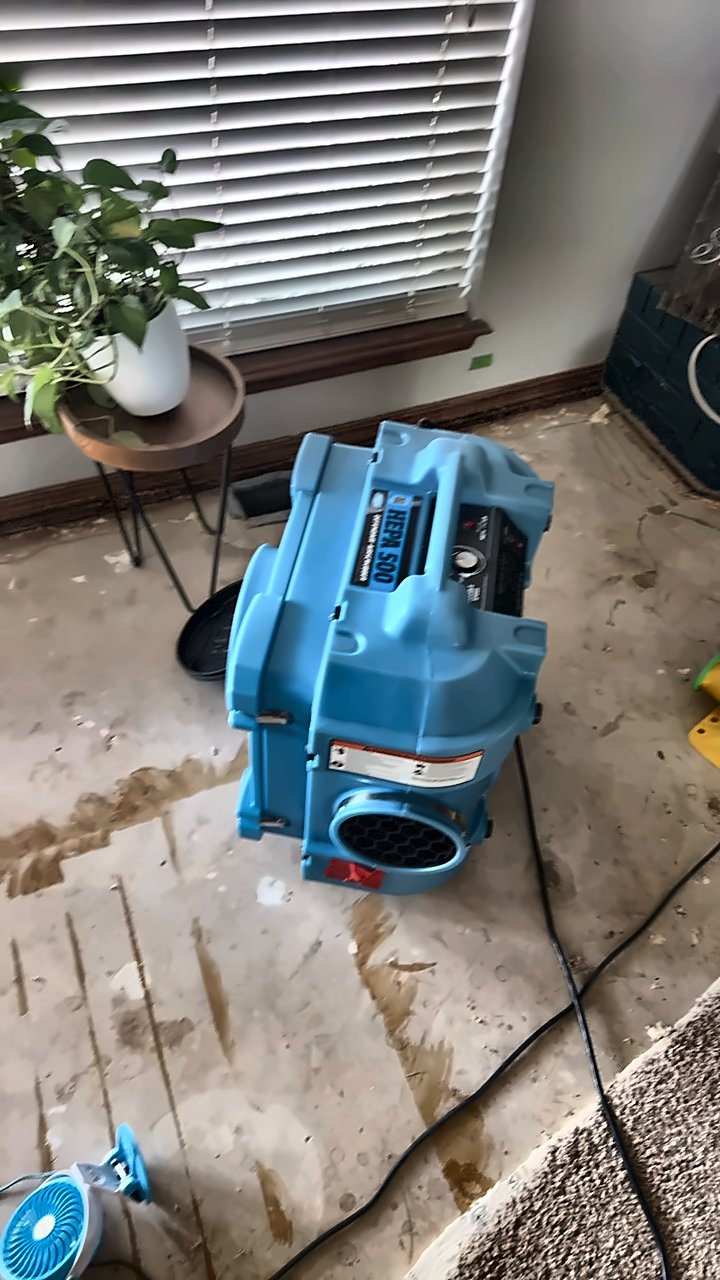
Flooring out, subfloor exposed, scrubber running: mid-dry-out on one of our water jobs. The staining on that subfloor is what standing water leaves behind — and exactly what has to be verified dry before anything new goes down.
The Insurance Piece: “Sudden and Accidental” vs. the Slow Leak
Here’s the good news that a lot of stressed-out homeowners don’t realize: a storm cause is usually the best case for coverage. This is where being organized pays off, so let me walk you through how adjusters generally look at it.
Most homeowners policies cover water damage that is sudden and accidental. A storm that rips shingles off and lets rain pour through the roof is the textbook example of sudden and accidental. The wind or hail is a covered peril, and the water damage that follows usually rides along with it. That’s very different from a leak you’d known about for months, which insurers tend to treat as a maintenance problem and deny.
Two distinctions worth knowing:
- Storm rain through a damaged roof is not the same as a flood. Rain coming in through a wind-broken roof is generally covered under your standard policy. Water that rises up from outside and comes in at ground level is “flood,” and that needs separate flood coverage. Same wet carpet, very different coverage path, so how the water got in matters.
- Mold coverage is usually tied to the covered event, and it’s often capped. When mold grows as a direct result of that sudden storm damage, many policies will cover the remediation, though a lot of them limit how much. When mold grows because a leak sat ignored, coverage usually disappears. This is exactly why speed and documentation matter so much: you want a clean, obvious line from “storm hit on this date” to “water intrusion” to “we dried it right away.”
Now the part I want every Oklahoman to hear clearly. When you file a claim, your insurer may hand you a “preferred vendor.” In Oklahoma, the choice of who works on your home is always yours. You get to pick who you trust, not who saves the insurance company a phone call. When my team takes a storm job, we document everything with photos and moisture readings, I write it up the way an adjuster needs to see it, and I’ll speak to your adjuster directly. In most cases what you end up paying out of pocket is just your deductible. One of my customers, Brittany, put it simply after we handled her claim: we “took great photos and notes for insurance, monitored daily and exceeded my expectations.” That’s the standard. Documentation is advocacy.
I’m not going to tell you what your specific policy covers, because I haven’t read it and anyone who promises you a coverage answer sight-unseen is guessing. What I can promise is that we’ll give your adjuster a clean, honest, thorough file to say yes to.
Why You Can’t Just Bleach It and Move On
Every few weeks I get a call that starts with, “We had a leak a while back, cleaned it up, but there’s this musty smell that keeps coming back.” Here’s what happened, and it wasn’t a failure on their part. They cleaned the surface. The water was in the structure.
Surface cleaning and a bottle of bleach handle what you can see. They do nothing for the wet insulation, the soaked back side of the drywall, and the spores that already settled into the wall cavity. Killing the top layer while the material underneath stays damp is like mowing weeds and leaving the roots. The smell comes back because the colony was never actually dry, and never actually removed. Spraying a biocide on carpet or into a vent without solving the moisture is a known dead end in my field, not a fix.
Real remediation is physical. You find every wet spot with instruments, not guesses. You seal off the work area so spores don’t ride your HVAC into the rest of the house. You physically remove what’s contaminated, clean what can be saved, and you dry the structure down to a verified normal moisture level so it can’t come back. If you want the full breakdown of how that’s done properly, I lay it all out on our professional mold removal process page. And because storm damage lives on the water side of the house, our water damage restoration page walks through the drying and structural side that has to happen first.
Mold is a serious thing to handle right. It’s also not plutonium. We contain it, we kill it, we remove it, and your house goes back to being your house. The people who get hurt by mold are usually the ones who let it sit for a year, not the ones who caught a storm leak and made a couple of calm phone calls.
How My Team Handles a Storm-Into-Mold Call
When you call our line, here’s what happens, and I want you to know the difference between what I do and what my crew does, because it matters.
I answer the phone, day or night, on our 24/7 emergency line. I triage what you’re describing, I tell you which of those safety steps to take right now, and I dispatch my response team, usually on-site within about an hour during metro hours. From there my technicians go to work. They read the walls and ceiling with moisture meters and a FLIR thermal camera, so we find the water you can’t see instead of tearing open drywall hunting for it. They set containment and run HEPA air scrubbers that pull 99.97% of airborne spores. They bring in industrial dehumidifiers and air movers and dry the structure down to a real, measured target, not a “feels dry” guess. And you get an update every single day, by text, call, or email, whichever you want.
I set the standard and I keep you informed. My team executes it. That’s how a family-run crew stays fast and stays honest at the same time. Lindsay, a customer of ours whose home we dried out, said it better than I can: “no pressure, but no nonsense.” That’s the whole job.
One more thing, on price, since it’s usually the next question. I won’t quote you a dollar figure over the phone for a job I haven’t seen, and I’d be careful with anyone who does. Storm damage varies wildly, one wet ceiling versus a soaked attic and three rooms, and the honest number comes from actually looking. That’s why the assessment is free. You get real eyes and real readings on your house before anyone talks about cost.
Frequently Asked Questions
How fast does mold really grow after a storm leak? Fast enough that you don’t want to wait around. EPA guidance says materials dried within 24 to 48 hours usually won’t grow mold, and after that the odds climb every day the material stays wet. The exact speed depends on how soaked things got and how warm the space is. Think of it as a threshold, not a countdown, and the safe move is to start drying and call quickly rather than watch the clock.
There’s just a small stain on my ceiling. Do I really need a professional? Maybe not, and I’ll tell you straight if you don’t. But the stain is the smallest visible part of the wet area, and storm water usually spreads above the ceiling where you can’t see it. A quick moisture check tells us whether it’s a surface issue you can handle or a wet cavity that needs drying. That check is free, and knowing beats guessing.
Will my homeowners insurance cover mold from a storm roof leak? Often, yes, when the mold is a direct result of sudden storm damage, though many policies cap how much mold coverage they’ll pay. The keys are that the cause was sudden and accidental, not a leak you ignored, and that you can document it. That’s a big reason to photograph everything and act fast. I’ll build the file your adjuster needs and speak with them directly.
Can I just bleach the spot and paint over it? Please don’t, at least not as your only step. Bleach and paint handle the surface, but storm water sits inside the wall and insulation. Sealing it up traps the moisture, and the musty smell comes back a few weeks later because the mold was never dried out or removed. Solve the water first, then the surface.
I waited a couple of weeks before calling. Did I blow it? No, and I’d never say “you should’ve called sooner,” because it doesn’t help and it isn’t true. A two-week-old leak is a bigger job than a one-day-old one, but it’s still very much fixable. We see it all the time. The best time to call was after the storm; the second best time is right now.
If a storm left you with a stain, a drip, or that musty smell that won’t quit, the calm next step is a phone call. Call 405-896-9088 and I’ll walk you through it, or text the same number if that’s easier. The assessment is free, the readings are real, and you’re going to be fine.
Phil Sheridan. Owner, 4D Restoration. Edmond, Oklahoma. IICRC Certified. Service-Disabled Veteran-Owned. 405-896-9088.